
Sights of Dissent
Updated: Aug 18
A Retrospective of the 2024 UCSD Encampments

Now that I've graduated, I thought I might try my hand at writing more. Back in my freshman year of high school, my history teacher at the time stressed upon us the importance of reading and writing - that it was like a muscle that had to be maintained, and I've taken that to heart for the most part, albeit with less emphasis on reading (reading novels is like the mental equivalent of leg day for me). I've never been a fan of journaling either, but this is probably as close as I'll get to it. Up 'till now, my writing and my art process as a whole have been very 'stream-of-consciousness,' and it's only in retrospect that I tend to derive meaning. In the same respect, I can't really say why I went to the encampments that day. If you asked me at the time, I might have said "to document the protests through my eyes." But why? I wasn't a journalist. I was barely a photographer. I've thought about it. I can't conjure up a reason for the life of me. Now, two years have passed. Hopefully in writing about it, I can at least get close.
The week prior, I remember walking along Library Walk and seeing the encampments pop up overnight. Two years out, it's more of an image and a feeling than a true memory. The sea of tents filled the otherwise empty field with a liveliness that I rarely saw as a commuter going to a school that's colloquially known as "UC Socially Dead." While I never believed that to be the case, the encampments gave me a bit of reprieve that I was right. Irrespective of the politics behind the encampments, it was a pleasant sight to see so many students united and gathering in an otherwise empty space, especially during the latter portion of a grueling school year. Aside from the quarterly tabling and vendor fairs, walking down Library Walk was typically a means to an end for most students, including me. For that week, it was the site of one of the biggest protests in university history.
Admittedly, while I kept up to date with the politics in private, the protest wasn't my largest concern at the time. Being a full time student, my attention was primarily on the big midterm I had on Monday for my psych methods class. It wasn't a particularly difficult course, but it was one that I would beat myself up over not doing as well in. I was never worried about failing the class, but I was worried about not putting my best, which I definitely wasn't. By that point, I was already watching lectures at 2x speed, doing the bare minimum work and still somehow managing decent grades. The weekend before the midterm, I was studying in my room when I saw a post that the encampment was defended against by counter protesters. Seeing the images, I was just glad that it wasn't nearly as bad as it was at other universities. All I knew was that there wasn't much time left for them, given how things went elsewhere. I needed to see it for myself before it was gone.
May 6, 2024
The morning of May 6, I got up early. Ridiculously early. My commute is 40 minutes without traffic, and my midterm was at nine in the morning. I planned to get to the last of my review the night before, but like most other midterms I'd taken up 'till then, I didn't. My plan was to go to the top floor of Franklin Antonio Hall, go to the study room on the west side of the building, and hunker down until I had to go downstairs to take the midterm while mumbling whatever slide I happened to see last. I left the house planning to get there with at least two hours to study. I had it planned to the letter. I knew the exact spot in the exact structure I'd park, as well as the route I'd take with my electric scooter. I had a Celsius in my bag to drink once I got there, and in my trunk was my camera bag. I brought my Nikon FM2 with a fresh roll of film hoping to take photos of the encampment after my exam. I hadn't taken analog photos in a while, and I was hoping talking with people at the encampment and capturing their experiences on film might be a good palate cleanser after a stressful test. But it didn't matter.
I got to campus just past 6. I drove in from the south side of campus, around the Revelle side of La Jolla Village Drive. But as I approached the first intersection, I saw something that made my heart drop. There were police setting up blockades entering the Theater District. I audibly exclaimed, "you've got to be fucking kidding me." Words that were only for myself until now. The parking structure I park at was at the north end of campus, so I continued along the road like usual. At each intersection, there was blockade after blockade blocking the entry to campus. As I was nearing the north end, I stopped at a red light and checked my phone. A Triton Alert, reserved usually for emergencies.

The email was sent while I was still driving; for around ten minutes, I didn't know that my midterm was already canceled. It would be about another hour until my professor knew. It happened earlier in the morning than most students even wake up, and staff weren't notified ahead of time. By all accounts, school was meant to proceed as usual until that email at 5:56 in the morning. I even had emails from professors and TA's the night before reminding us of what to prepare for the upcoming week. But that didn't matter. Instead of going straight at that intersection, I turned left toward Gliderport, a dirt parking lot. I opened my trunk and took out my electric scooter and camera bag, riding up toward the Rady School of Management. I climbed up a flight of stairs to RIMAC, left unguarded by the cops at the intersections, and made my way down to Library Walk. As I got closer, I heard the chants. The first thing I saw was the flattened tents.


I snuck around the side and parked my scooter to get a better look at the scene from behind as the protesters gathered behind a line of police further down Library Walk. It looked like a ghost town. Remnants of a place where people lived for the better part of a week, taken down in an instant. I never liked looking at this open area between Library Walk and RIMAC walk; pale-gray eucalyptus trees peppered the area like a plague, a forest with no end or beginning giving a semblance of nature amongst the university buildings, but for that week, it was lively. And in that moment, I was sad. I knew even then my memory of this spot would be tainted forever. As I tried to wade a bit closer toward the tents, my steps crunched the leaves beneath my feet, catching the attention of a nearby cop. He immediately turned his attention toward me. He was on edge, but dropped his guard upon seeing my camera. He kept an eye on me, baton in hand, as I captured the scenes.

I made my way back around to where the protesters were. There was a crowd of protesters gathered in front of the Target, a line of Highway Patrol officers holding them to a line just in front of Price Center. Looking on the UCSD subreddit, the officers gathered in front of the encampment not even an hour before and herded the group here. Those who resisted were held by police in Price Center, which they were using as a staging ground. They set up barricades to further separate them, dozens of zip-tie cuffs attached to their belts.

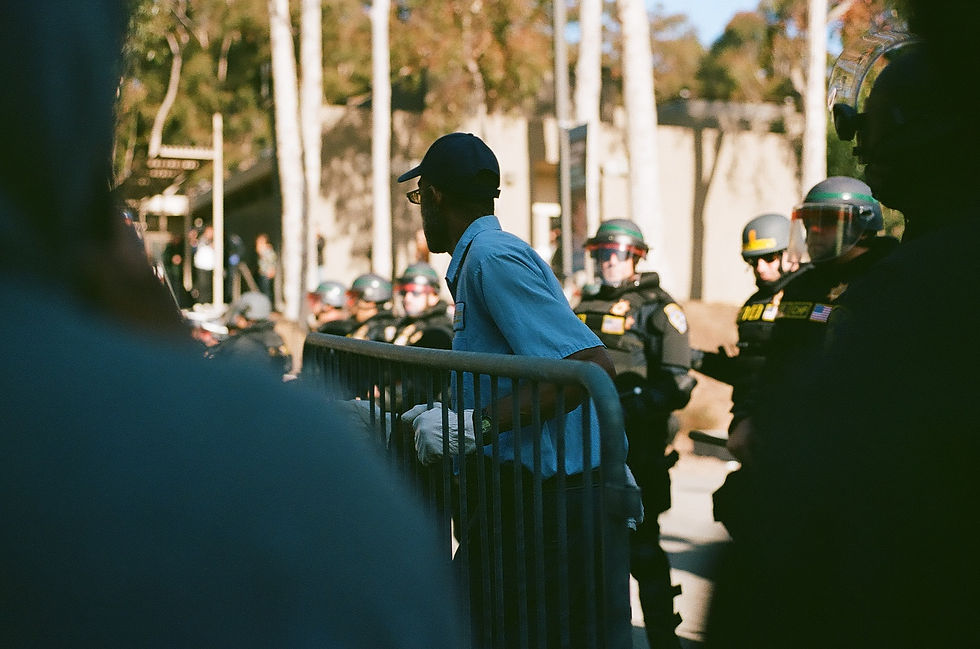

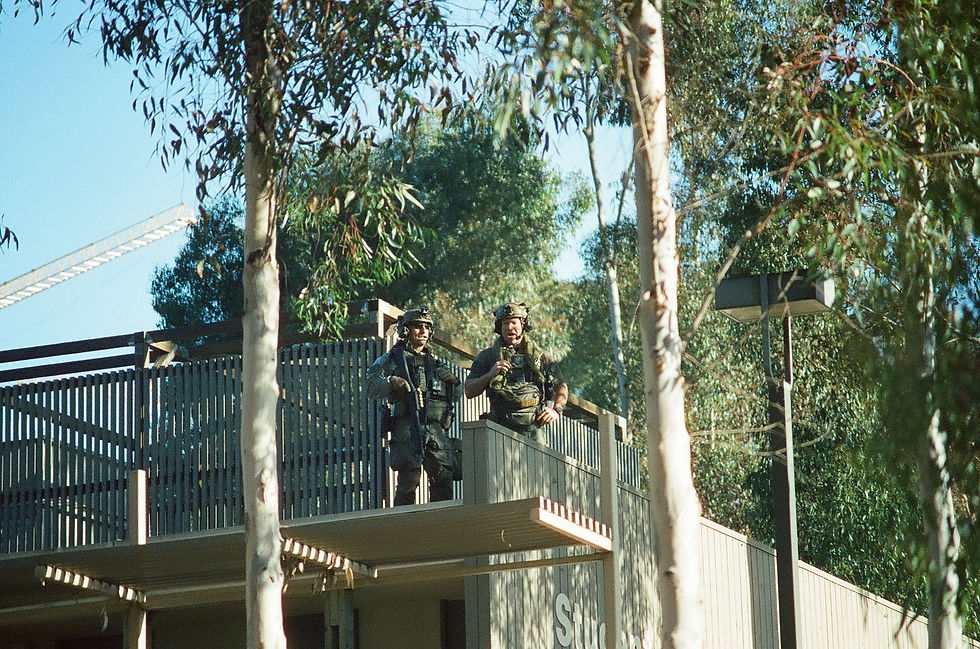
One of first things I saw when I was arriving at the scene were a couple of cops standing on top of the Student Health Services Center, seemingly jeering at the protesters below. They yelled something down to the crowd, though I couldn't make it out myself. Those first thirty minutes, the police behind the front line appeared to be somewhat confrontational with the protesters, albeit implicitly. One officer brought an opened case of water bottles to the line, offering it to police with a smirk. Some of the protesters recognized it as being confiscated during the raid, though I couldn't verify for myself whether this was the case. More jeers and boos from the crowd filled the air between chants.
Recently, I'd heard a conspiracy theory that UCSD was designed in a manner that would make it easier to suppress protests; many of these centered around Revelle plaza, which had a large open area that was overlooked on all sides by tall buildings that would make it easy for snipers to gain a vantage point. Looking back at these images, it's easy to see why such a rumor would spread. It looked more like a police checkpoint than a college campus by the time the barriers were fully set up. While the previously mentioned cops at the top of the Health Services Center didn't have rifles, it was eerie to see how a building usually reserved for aiding students was now threatening to harm them.

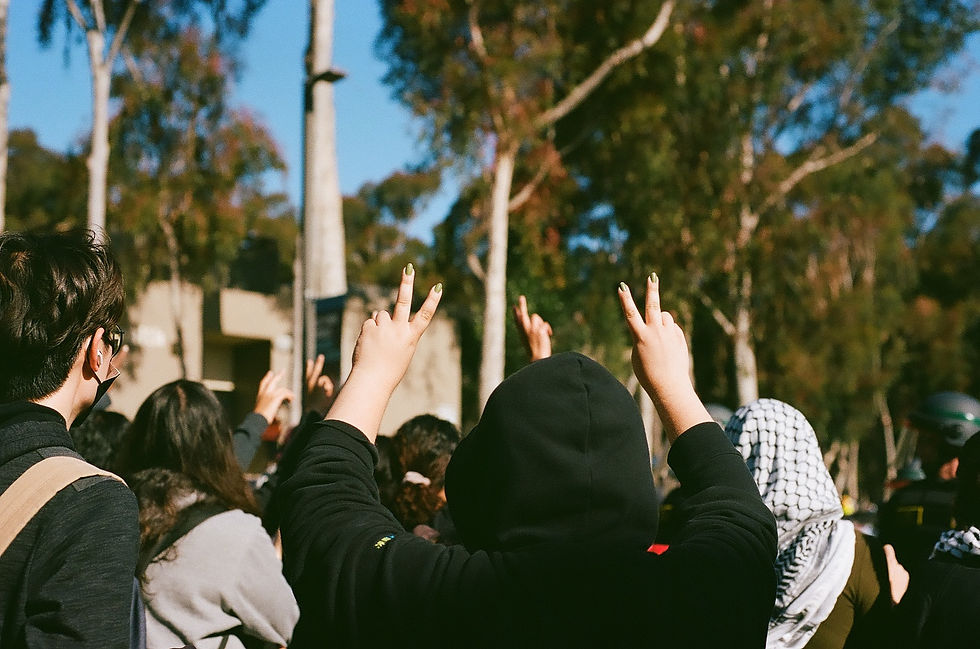
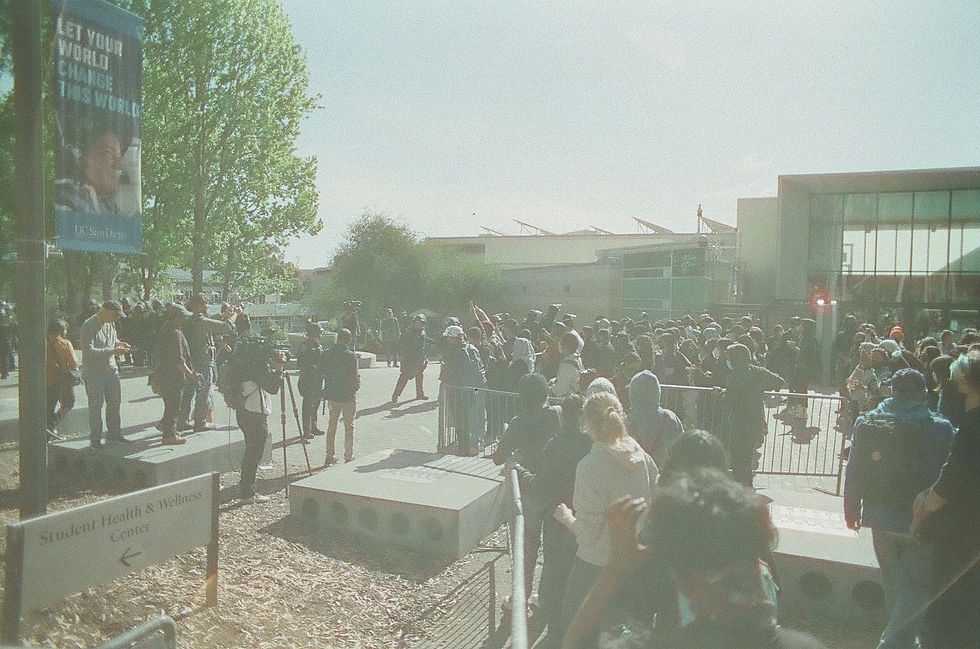
On the protestor side, there was a lot of anger. Among the most memorable chants I heard was "Why are you in riot gear?!" followed by "There is no riot here!" In between chants, there were moments of brief calm. Protesters would often hold up peace signs reinforcing their non-violent philosophy. Though it's difficult to temper the attitudes of a crowd of protesters forcibly removed from their protest site, there was a surprising amount of restraint and cooperation all around. As most protesters confronted the police, there were a number of younger protesters behind the line coordinating amongst themselves to gather supplies, make signs, and determine where the police would try to escort the arrested protesters out. At one point, a protestor asked around for hand sanitizer, to which I offered the bottle I had on hand. They gave a quick thanks before passing it on to the next protestor. Most of the signs I saw were ripped from the pages of journals, hastily written. Presumably, their previous signs were left at the encampment.
"From Palestine to Mexico!"
"From Palestine to Mexico!"
"All these wars have got to go!"
"All these wars have got to go!"
"From Palestine to the Philippines!"
"From Palestine to the Philippines!"
"Stop the U.S. war machine!"
"Stop the U.S. war machine!"
The real test of their restraint came when the police broke the line to reposition and prepare to move the arrested protesters out. They lifted the barriers. Almost immediately, they started to move in to confront the police even closer. I had just loaded a new roll of film into my camera as the barricade broke. I hastily took photos without adjusting my ISO to match the new film, fearing a missed moment. As soon as they approached, however, shouts rang out from the crowd as the police drew their batons, and the crowd stood down, holding up peace signs again. I admit, looking at the scene from the side, I was worried it'd get hairy. The previous week, I watched scenes from Columbia and UCLA playing through the news, with violent clashes between protesters and counter protesters, but they were determined to maintain their composure.




By this point, I stepped back for a moment. A few other protesters were trying to figure out where the police would come out from. With my scooter, I circled around a couple of times surveying the area. At one point, a couple protesters suggested the south side of the building. I climbed up the stairs to the entrance to the south side, seeing faint outlines of movement from outside, but not much. Eventually, the protesters began migrating to the north side of Price Center, where a number of police stood guard at the top of the steps leading to the second floor. I had just shot the last exposure of my third roll of film, and sat on the side watching more protesters move in. As I sat, I prepared to leave, thinking I had exhausted my film supply. Luckily, looking in an obscure pocket of my bag, I found one last roll of Fuji 400. Loading the last roll I had, we moved down to the roundabout at the north end of Price Center, where two Sheriff's buses parked.


Once it was clear the police were moving the arrested protesters out from the roundabout side of Price Center, people moved quick to block the path to the buses. I parked my electric scooter to the side, shooting more conservatively to save on my last roll. Little did I know, I'd soon have a lot more reasons to shoot. A few protesters with megaphones led the chants, overlooking the crowd as they blocked the entrance. It wouldn't matter, though. Deputies began clearing a way from Price Center, forming a new line to clear all the way to the buses.


This was the moment where it became real for me, though my senses dulled. With analog photography, the tactile nature of the camera usually forces you to slow down and consider what you're shooting. But in that moment, I would have killed for one of my digital cameras. I took shot after shot without adjusting exposure or focus, just hoping to get shots that'd stick. I tried and failed to get images of the protesters being led to the bus, as the deputies kept their heads down as they escorted them through the line. Anyone who got close was pushed back. All I could do was watch. The only thing keeping me safe was the forty year old camera between myself and the police. I was invisible, and it worked to my benefit most of the time.
I looked back at my scooter, and it had been knocked over in the chaos. As soon as it was clear the protesters weren't going to make any attempts to break their arrested comrades away, most moved to the front of the bus, blocking its way out. Some banged on the side of the bus. The front line shifted again, with protesters ready to hold the line again. More and more bodies piled in front. More chants. Claps in rhythm.
From the megaphone: "UCPD, KKK!"
The crowd lit up in response: "UCPD, KKK!"
"IDF, you're all the same!"
"IDF, you're all the same!"
There was a brief moment where it really looked like the protest had stopped the police dead in their tracks. The crowd blocked the only way out for the oversized paddy wagons. Peace signs raised high above the crowd, Palestinian flags raised even higher. I tried to see if I could get a look at my scooter from my vantage point, but it was already lost in the sea of people. I didn't care at that point whether it'd get stolen or not. I just worried about shooting this last roll.
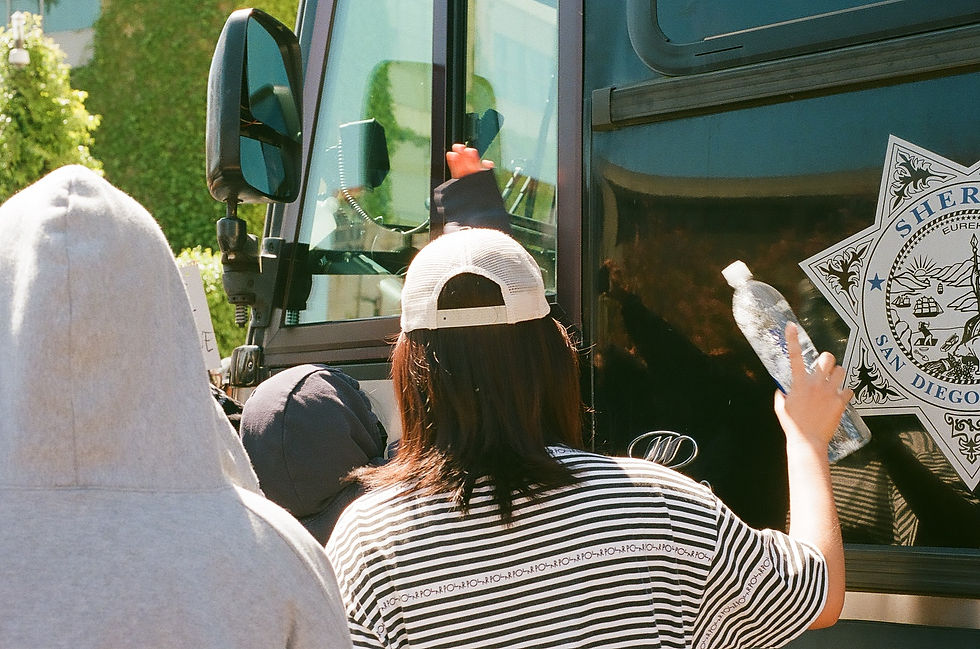


I was naive enough to think it was over. That the cops would be caught in a perpetual standoff. The chants continued for a bit, but seemed to die down slightly. I had an uneasy feeling build in my stomach. The protesters wouldn't let them go, but the police were determined to bring their catches back to jail and dismantle the protests. It felt like an impossible situation that couldn't be resolved with anything other than blood.
And then I turned around.

I was among the first to notice. My eyes widened. All of a sudden, one front became two, and the protesters were about to get caught between cops on either side. Sirens and horns rang out from the bus. I ran back, not wanting to get caught in the mix. Some shouts from the crowd alerted those in the rear of the incoming storm. Fear and confusion spread through the crowd, unsure of where to focus their attention as the deputies guarding the bus began to push back down the road, leading them toward the approaching officers coming in from behind.

As the Sheriff's deputies pushed the protesters back, the bus inched forward, forcing the protesters to move defensively. I remember seeing protesters at each level of the line double taking, realizing the danger they were in. The densely packed group gained distance, trying to take as much ground as possible before they were squeezed, only for the deputies to regain that territory back as the front of the line dispersed more.


Everything happened so quick. I had to run down the road to keep pace with their movements. Eventually, there were no more united fronts on either side. Only a chaotic blend of protesters and police pushing against one another. Further down, the police moved like a dagger cutting through the crowd, breaking and pushing them to the side away from the bus. It wasn't long before the buses cleared away. Eventually, there was enough of a clearing near the end of the road that the bus was able to speed off. A few of us ran along the end, watching as they receded into the distance. Looking back, the cops joined us too.

I took a moment to catch my breath. I felt defeated. Emotions ran high among the crowd. Screams and cries filled the air, yet neither side was done yet. Now that the cops had their bus clear, their attention focused entirely on the remaining crowd. The now-dispersed crowd was a threat. From my view on the sidewalk, I could see the fear on one officer's eyes as they were suddenly surrounded by a scattered group of protesters. The aggression grew. A few lone protesters breaking from the crowd were chased down. They were desperate to regain control of the situation now that their first objective was complete.
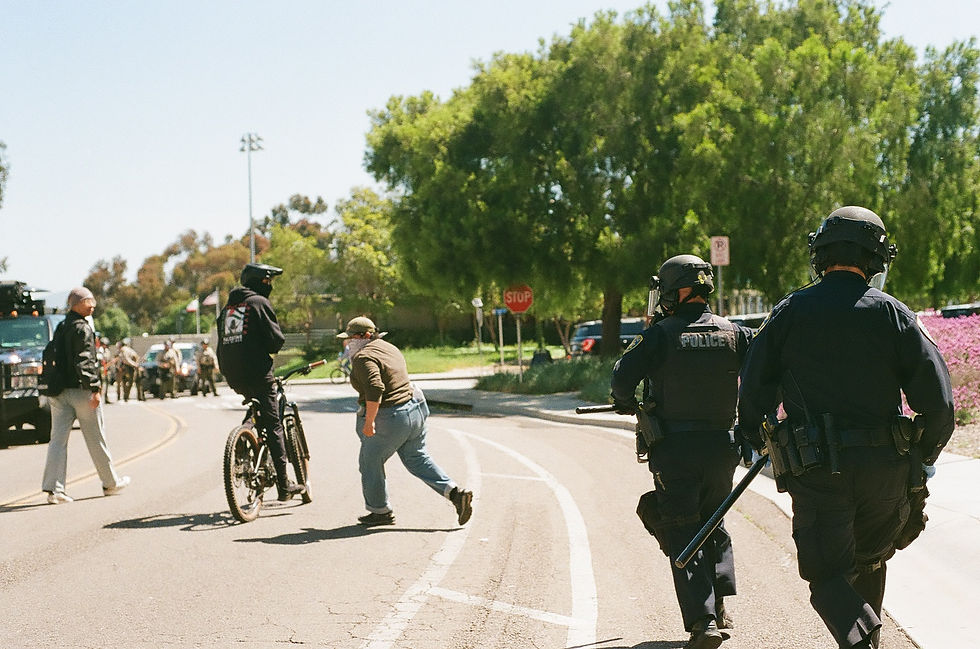
This was the last photo I took on my FM2. A few officers cornered a protestor that broke from the crowd, and another stood between the two and argued with the police. I couldn't make out what they were saying.

Once my shot counter read '36' and my advance lever turned stiff, I had a dizzying feeling hit. As the crowd came back together in a more organized standoff between protestor and police, I found myself in a safe alcove, behind the madness, now from the perspective of the police. I felt uneasy simply being physically on this side. There was an emptiness there. Space unused. Taken up. And in front of me, the protesters, forced into a corner, being led under threat of baton. I put down my camera, the one thing protecting me from the same wrath, the same oppression I spent the past couple hours trying to document.
In front of me was a Palestinian flag with a bent flagpole in the middle of the road, behind the line of police. I stared at it for a moment. A static object in this moment of chaos. I stepped forward, reached down, and picked it up. I walked on the sidewalk, past the officers to the protesters' side. Almost immediately, a man ran up to me, grateful. He mustered up a few thank you's as it slipped from my hands to his. I turned back around, now with the crowd, staring back at the police. The cop nearest to me, who had seen the whole confrontation, glared me down for a few minutes as I joined them. I pulled out my phone, the same kind of tool the protesters used, and captured the scene, now from their side, considerably more claustrophobic. I locked eyes with the cop at the edge of the line. It was a different look than I was used to after hiding behind a camera for a while.

At this point, I decided to leave. I walked back up toward Price Center, passing discarded signs, umbrellas, and flags lost in the chaos as though I was wading through a battlefield. I was prepared to walk the full mile back to my car in contemplation, thinking that my scooter surely would have been lost or stolen in the chaos. As I approached the roundabout where the chaos started, I saw my scooter neatly stood up at the edge of the sidewalk, untouched.
Comments